Twilio + custom code vs hosted voice AI: the real cost comparison
Building voice AI on Twilio sounds cheaper until you add up the engineering hours, the SDK glue, and the year of maintenance. Here's the honest math.
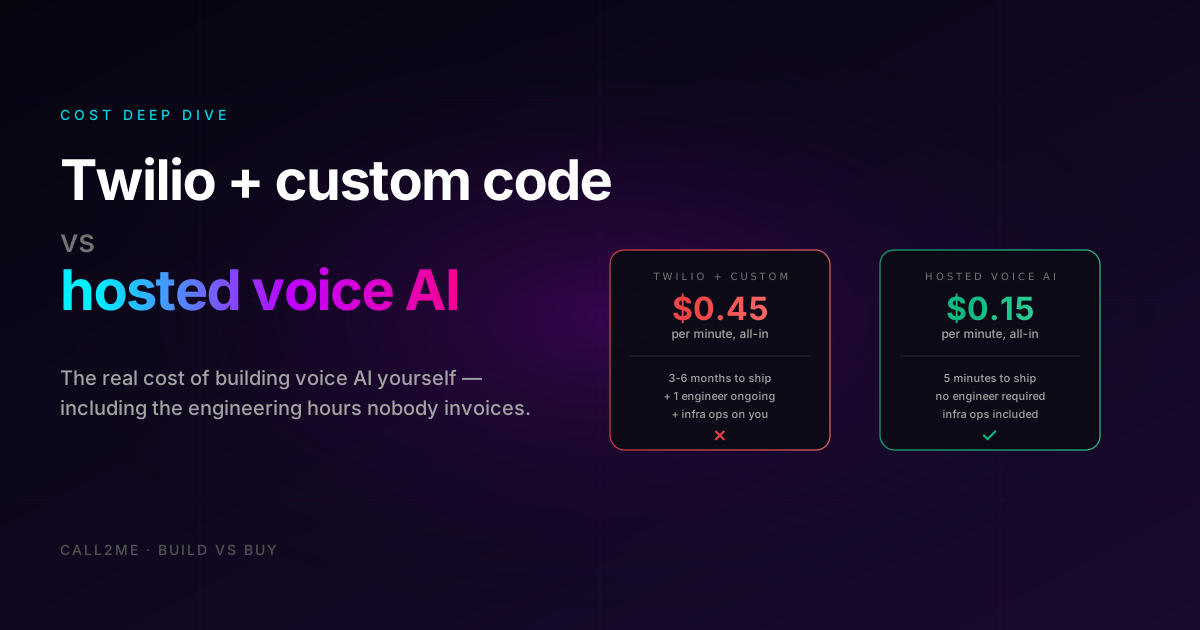
If you're a senior engineer and someone asks "how do we add voice AI to our product?", your first instinct is reasonable: just use Twilio. Twilio has the phone numbers, the SIP, the WebRTC, the recording. We have the engineers. How hard can it be?
Pretty hard, actually. Or rather: not technically hard, but expensive in ways that don't show up in the Twilio invoice.
This post is the build-vs-buy math for a team considering building voice AI on Twilio + their own STT/LLM/TTS plumbing, versus using a hosted voice AI platform.
For 95% of teams, hosted voice AI wins on total cost of ownership in the first year, even if Twilio's per-minute rate looks cheaper. The exception is if voice AI is a core differentiator of your product and you're committing a senior engineer to it full-time for a year.
The Twilio bill — what you actually pay
Twilio's published rates for a US voice call:
| Component | Cost |
|---|---|
| Inbound voice (US local) | ~$0.0085/min |
| Outbound voice (US local) | ~$0.014/min |
| Phone number rental | $1.15/month per DID |
| Programmable Voice add-ons | varies |
| Recording storage | $0.0005/min/month |
Looks cheap. Now add the AI stack Twilio doesn't include:
| Component | Cost |
|---|---|
| Speech-to-text (Deepgram Nova-3) | ~$0.0043/min |
| LLM (GPT-4o, conversational) | ~$0.02/min |
| TTS (ElevenLabs Flash) | ~$0.03/min |
| Vector DB for RAG (Pinecone or self-hosted) | $70-200/month base |
| Server hosting (always-on for streaming) | $50-300/month |
Per-minute that's roughly $0.07/min of variable cost. Plus $120-500/month of fixed infra. That's the easy part to estimate.
The bill nobody invoices: engineering hours
Building a usable voice AI on Twilio involves shipping all of:
- Twilio Programmable Voice integration (TwiML or Voice SDK)
- WebSocket bridge for streaming audio in/out of your STT and TTS
- Streaming STT pipeline with partial transcripts and endpointing tuning
- LLM orchestration with streaming token output
- Streaming TTS with token-level synthesis (so first phoneme plays before LLM finishes)
- Interruption handling (caller talks over the agent)
- VAD (voice activity detection) — Silero or similar
- Knowledge base ingestion (PDF parser, chunker, embeddings, vector store)
- RAG retrieval logic that runs in parallel with the LLM, not after
- Webhook delivery system with retries
- Recording storage and transcript indexing
- Call analytics dashboard
- Multi-tenant auth if you're reselling
- Per-tenant configuration UI
- Function calling / tool use for transfers
- Error handling for SIP edge cases (one-way audio, codec mismatch, jitter)
- Regional deployment for latency
- Monitoring, alerting, on-call rotation
A senior engineer at a market salary plus benefits costs roughly $15,000-25,000 per month. The above scope is a 3-6 month project for one focused engineer, or 2-3 months for two. After launch you need at least 0.25-0.5 of an engineer ongoing for maintenance, model upgrades, edge cases, and the inevitable "why is one specific Verizon caller getting cut off?" debugging.
That's $45,000-150,000 to ship, plus $50,000-100,000/year ongoing.
The all-in comparison
For a team doing 10,000 minutes/month of voice AI traffic:
The variable cost difference of $500/month is real. The setup cost difference of $45,000-150,000 is also real. The latter pays for the former for 8-25 years before the math flips.
Twilio is cheaper per minute. Hosted voice AI is cheaper per year. Pick the unit that matches your actual decision.
When Twilio + custom genuinely wins
Two scenarios where building on Twilio is the right call:
1. Voice AI is your product
If the voice agent IS the thing you sell — not a feature, the entire product — then you need full control over the stack. Custom STT models, custom LLM fine-tunes, proprietary voice cloning. A hosted platform won't give you that.
This is a small fraction of teams. Most "we do voice AI" companies are wrappers on the same provider stack everyone else uses.
2. You already have telephony infrastructure
If you already run Twilio at scale for other reasons (SMS, OTP, existing voice products) and have the engineering team and operational maturity, the marginal cost of adding a voice AI flow is lower. You're not starting from zero.
For everyone else — agencies adding voice AI to their stack, SaaS companies shipping voice as a feature, restaurants automating reservations, support teams deflecting tier-1 tickets — the hosted path is dramatically faster and cheaper in the first year.
What you give up by going hosted
Honest list:
- Less plugin freedom. Hosted platforms support a fixed (large) set of STT/LLM/TTS providers. If you need an unusual model, you can't bolt it in.
- Vendor risk. Your voice AI runs on someone else's infrastructure. If they go down, you go down. (Note: same is true if your custom stack runs on AWS and AWS goes down — but you tend to remember the vendor lock-in story when it's not your own infra.)
- Less itemized billing. Hosted platforms tend to bundle into per-minute pricing. If you need to rebill clients per token of LLM usage, that's harder.
If those three trade-offs are deal-breakers for your team, build on Twilio. If they're acceptable, the math says use a hosted platform.
The 90-minute test
Before you commit to either path, do this:
- Build the same agent on both. Spin up a Call2Me account (free, 5 min) and build your target agent. Then map out what it would take to build the same agent on Twilio + your stack.
- Time the work. How long did the Call2Me version take? How long would the Twilio version take? Multiply the latter by your engineer's hourly cost.
- Compare. The number usually settles the argument quickly.
Read next
- Call2Me vs Vapi: an honest side-by-side — comparing the two leading hosted platforms.
- Sub-500ms voice latency, explained in budgets — the engineering picture of what you'd be building.
- Your Brand. Your Platform. — for agencies who want to resell voice AI without building infrastructure.