Voice AI for real estate: lead qualification, showing booking, and after-hours capture
How real estate brokerages and individual agents use voice AI to qualify inbound leads in 30 seconds, book property showings into the calendar, and stop losing buyers who call after 6pm — with the patterns that actually convert and the ones that just frustrate.
Real estate is a phone-driven business that has been pretending to be email-driven for fifteen years. The buyer who actually closes is rarely the one who fills out the contact form — it's the one who picks up the phone after seeing a listing, has a question, and decides in the next 90 seconds whether to keep going or move on to the next listing.
If your agent doesn't pick up that call, the lead is gone. Not "we'll follow up tomorrow" gone — gone to the next listing on Zillow, Sahibinden, or Idealista. Voice AI exists for exactly this moment.
The math nobody wants to do
A mid-sized brokerage tracked their inbound call response rate for one quarter. The numbers were uncomfortable:
- 41% of inbound calls answered live
- 22% answered with delay (voicemail → callback within 1 hour)
- 37% effectively lost (no answer, no callback that day)
Of the 37%, a follow-up survey found that 68% had already engaged another agent or moved on by the time anyone called back. That's roughly a quarter of all inbound leads evaporating before the brokerage could speak to them.
A voice AI that picks up every call inside three rings doesn't replace the agent. It replaces the silence.
The three patterns that work
Pattern 1 — Inbound qualification
The buyer calls about a listing. The AI answers, confirms which property they're calling about (using the listing ID, the address, or even just the price), and runs a 4-question qualifier:
- Are you pre-approved for financing, or paying cash?
- What's your timeline — within 30 days, 60–90 days, or just exploring?
- Are you working with another agent right now?
- Would you like to schedule a showing this week?
If the answers signal a serious buyer (pre-approved + 60-day timeline + no other agent), the AI books a showing on the agent's calendar and texts the agent immediately. If the answers signal a tire-kicker, the AI sends a polite confirmation email and adds them to a nurture list — no agent time burned.
The qualification script lives in your knowledge base and you tune it over time. Most brokerages stop dropping unqualified leads on agents within the first week.
Pattern 2 — Showing booking
This is the highest-leverage use case in real estate. Buyer says "I want to see the place tomorrow at 5." The AI checks the agent's calendar, the listing's availability rules (some sellers require 24h notice, some don't allow weekends), and either books the slot or counter-offers two specific alternatives.
Agents stop being the booking bottleneck. The buyer doesn't have to wait for "let me check and get back to you." Showings get booked while the lead is still warm.
Pattern 3 — After-hours capture
55% of property inquiries happen between 6pm and 11pm — when the buyer just got home from work and is actually browsing. Almost no brokerage has a human picking up the phone at that hour.
The AI takes the call, answers basic questions about the property (square footage, HOA fee, school district, taxes), captures lead info, and books a callback or showing for the next morning. By 9am, the agent has a qualified lead waiting in their inbox instead of a missed call from 8:47pm.
What goes in the knowledge base
A real estate voice agent needs four data sources, all of which you already have:
- Active listings — address, price, beds/baths, square footage, key features, photos URL, listing agent. Sync from your MLS / IDX feed.
- Showing rules per listing — minimum notice, blocked hours, lockbox vs. agent-accompanied, pet warnings.
- Agent calendars — Google Calendar, Outlook, or your CRM (Follow Up Boss, kvCORE, BoomTown, Salesforce).
- Office FAQ — commission policies, financing partners, current market rates, area-specific tax info.
The AI never invents a listing. If a caller asks about a property the AI doesn't know about, it says so and offers to take a message. This boundary matters — guessing about price or square footage on a half-million-dollar transaction is how you get a complaint to the broker.
What it should never do
Voice AI in real estate has clear limits:
- Never quote a final price below list. Negotiation belongs to the agent. The AI confirms the asking price and books the conversation.
- Never answer fair-housing questions about neighborhoods. "Is this a good neighborhood for [protected class]?" is a legal landmine. The AI politely redirects to the agent.
- Never give legal or financial advice. Mortgage rates, closing costs, tax implications — the AI provides general info and routes specifics to the lender or attorney.
Building these guardrails into the prompt is a one-time setup. Once they're in, you don't think about them again.
Outbound: the underrated half
Most brokerages think about voice AI as an inbound tool. The bigger ROI is often outbound:
- Open house follow-up. Sunday's open house had 14 sign-ins. Monday morning the AI calls all 14, asks if they have questions, and books showings for the serious ones. An agent doing this manually would lose half the day.
- Listing anniversary callbacks. Past clients on their 1-year, 3-year, 5-year ownership marks — the AI checks in, asks if they're thinking about buying / selling / referring anyone. Low-pressure, high signal.
- Expired listings outreach. Listings that came off the market unsold are warm leads. The AI runs a respectful outreach script and routes interested sellers to a listing agent.
These are jobs no one in the office wants to do consistently. The AI does them on schedule, every week, without burning out.
A realistic conversation flow
Caller: Hi, I'm calling about the listing on Maple Avenue.
AI: Sure — that's the four-bedroom at 1420 Maple, listed at $589,000. Are you calling about that one?
Caller: Yes. Is it still available?
AI: It is. It came on the market last Tuesday and we have one showing scheduled. Would you like to see it this week?
Caller: Maybe Saturday morning.
AI: Saturday at 10am or 11:30am — either works for the listing agent. Which would you prefer?
Caller: 11:30.
AI: Done. I have you down for Saturday at 11:30am at 1420 Maple. Could I get your name and a number to send the confirmation?
That whole exchange takes 90 seconds. The agent learns about it in a Slack notification with the lead's name, number, and the qualification answers, and shows up Saturday with everything they need.
What it costs
Real estate voice AI usage is bursty — a few high-volume hours around new listings going live, then quiet stretches. Per-minute pricing makes sense; you're rarely paying more than a few hundred dollars a month for an active brokerage. The math against losing one transaction is not close.
Common mistakes
- Treating it as a 24/7 receptionist that just takes messages. The whole point is qualification and booking, not voicemail-with-extra-steps.
- Skipping the calendar integration. Without live calendar access, the AI books over the agent's other appointments and creates worse problems than it solves.
- No human handoff trigger. There has to be a clear "transfer me to an agent" path, both for the caller and for the AI when the conversation goes off-script.
- Overloading the qualification script. Four questions is the sweet spot. Eight questions and the buyer hangs up.
Ready to deploy?
If you're a brokerage owner staring at last quarter's lead-to-conversion numbers and wondering where the leak is, voice AI is almost certainly the cheapest place to fix it. A two-week pilot on a single team usually answers the question of whether it pays for itself — in our experience, it does, and faster than expected.
Talk to us about a real estate pilot →
Keep reading
All posts Healthcare
Voice AI for dental practices: pain triage, recall calls, and the no-show problem
Dental practices have a different phone problem than general clinics — pain triage decisions, slot-type matching for cleanings vs procedures, insurance pre-checks, and a no-show rate that quietly eats 8-15% of revenue. How voice AI handles each one.
May 13, 20267 min E-commerce
Voice AI for e-commerce: order status, returns, and abandoned-cart recovery on the phone
How online retailers use voice AI to handle the four calls that swamp support — where is my order, can I return this, did my refund go through, and the abandoned-cart save call that pays for the entire system.
May 13, 20267 min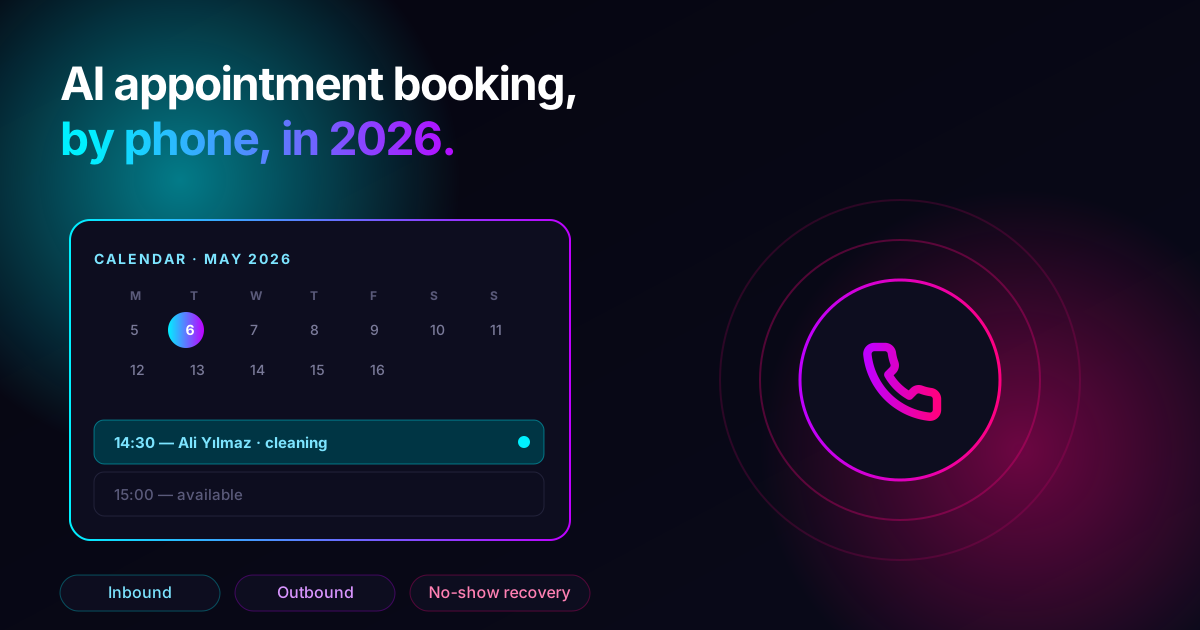 AI Appointment Booking
AI appointment booking by phone: the patterns that work in 2026
Three flows do most of the work in voice-AI appointment booking — inbound capture, outbound confirmation, no-show recovery. Here's how each one is built, what to wire it into, and the trade-offs nobody mentions until you ship.
May 6, 20266 min