Voice AI vs IVR: which one should you actually use in 2026?
IVR phone menus annoy callers and lose deflection rates. Voice AI sounds human and handles the same calls for less. Here's the honest comparison — when each one still wins.
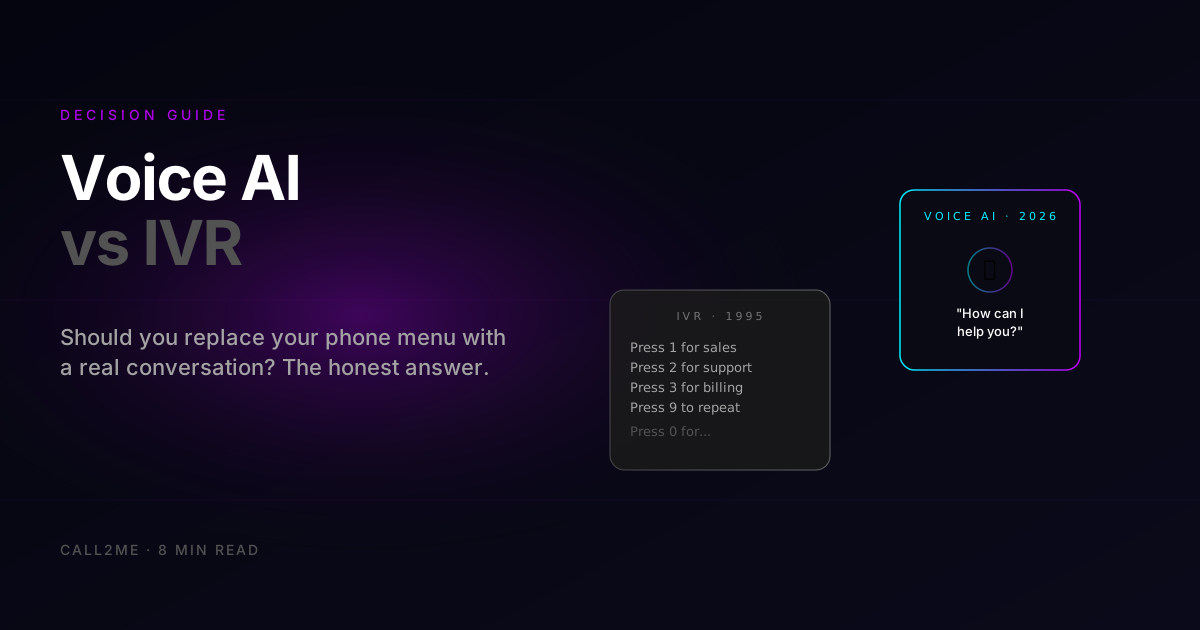
If you have ever called a phone number and heard "Press 1 for sales, press 2 for support, press 3 for billing — for all other inquiries, press 9...", you have talked to an IVR. Interactive Voice Response systems have been around since 1995, and most enterprise phone trees still use them.
In 2026, you have a real alternative. Voice AI answers the same call with a natural conversation: "Hi, this is the virtual assistant for Acme — how can I help you today?" The caller says what they want; the agent handles it.
This post is the honest comparison. When does each one win, and when should you migrate?
For most small-to-medium business phone use cases in 2026, voice AI is now strictly better than IVR — same job, lower caller drop-off, comparable cost. IVR still wins in two narrow situations covered below.
What each one actually is
IVR (Interactive Voice Response)
A scripted phone tree. The caller hears a recorded menu, presses keypad digits to navigate, and either gets routed to a human or hears another menu. The script is fixed: every caller goes through the same options in the same order.
Built on technology from the 1990s. Still ubiquitous because nobody wanted to pay to replace it.
Voice AI
A real-time conversational agent. The caller speaks naturally, the agent understands intent, asks clarifying questions, looks up information from a knowledge base, and either resolves the request or hands off to a human. Each call is dynamic — the agent adapts to what the caller actually needs.
Made possible in 2026 by sub-500ms latency in the STT + LLM + TTS pipeline. (For the engineering picture, see our latency deep dive.)
Side-by-side: where each one wins
The pricing row is real and worth unpacking.
The cost story
IVR is cheap per minute because it's mostly just playing pre-recorded prompts and reading keypad digits. Voice AI costs more per minute because it's doing genuine speech recognition, language model inference, and text-to-speech in real time.
But per-minute is the wrong unit. The unit that matters is per resolved call.
A 3-minute IVR call at $0.01/min costs $0.03. A 1.5-minute voice AI call at $0.15/min costs $0.225. Per-minute voice AI is 7x more expensive. Per captured booking or resolved ticket, it's often cheaper once you factor in:
- The 20-40% of IVR callers who hang up before reaching a human (those are lost bookings, lost tickets, lost customers).
- The human handle time that would have followed an IVR transfer (gone — voice AI resolves more on first contact).
- The setup and ongoing maintenance of an IVR script (gone — voice AI is a prompt edit).
When IVR still wins
There are two situations where IVR is still the right call.
1. Pure routing at extreme scale
If your one and only goal is "route 100,000 calls a day to one of 5 departments," and you're confident every caller knows which department they need, IVR's per-minute cost wins. Telco support lines and big bank front doors fit here.
2. Highly regulated, deterministic flows
Some compliance regimes (healthcare triage in some jurisdictions, some financial verification flows) require a documented, deterministic decision path that's the same every time. Voice AI's adaptive behaviour is a feature for users and a problem for auditors. IVR's rigidity becomes an asset.
For everything else — reservations, support, lead qualification, after-hours coverage, appointment scheduling — voice AI now wins on caller experience, deflection rate, and total cost of ownership.
The migration path
If you have an existing IVR and want to test voice AI without ripping it out:
- Spin up a voice AI agent for one specific use case — say, "after-hours reservations only." Five minutes on Call2Me.
- Forward your existing line to the AI for off-hours or as a "menu option" inside your IVR ("press 0 to talk to our virtual assistant").
- Compare outcomes for two weeks: capture rate, average handle time, caller satisfaction. The numbers usually tell you what to do next.
- Scale based on what works. You don't have to migrate everything at once.
For most SMB phone use cases in 2026, an AI receptionist replaces a 10-year-old IVR for less ongoing cost, better caller experience, and a fraction of the setup work. The exceptions exist — but you'll know if you're one of them.
Try it free
Build a voice AI agent for one of your call types this afternoon and forward your line to it for one evening. The data answers the question for you.
Build your voice AI agent free →
Read next
- How to set up an AI receptionist for your restaurant — concrete tutorial for the most common use case.
- Twilio + custom code vs hosted voice AI: the real cost comparison — for teams already on Twilio thinking about building this themselves.
- Sub-500ms voice latency, explained in budgets — the engineering picture of why voice AI now sounds human.